Winter Woodshedding, the Path to Sadhana

The last few months have been pretty hard-core winter here in New Jersey.  It’s cold, often grey, and the days have been short.  It’s not my favorite weather, though I’ve made a good faith effort to embrace the energy of the season and put it to good use.  Hence the intense practicing.

I haven’t been doing any traveling or concertizing, just holing up in my basement room, shedding away.  “Shedding” is short for “woodshedding,” a term jazz musicians coined that means going deep into practicing.  (Some of the major jazz musicians in the early part  of the 20th century were banished by their families to practice in the backyard woodshed . . .)  In the Hindustani realm we call it “riaz”, which basically means dedicated practicing.  “Sadhana” is yet another level, where the practicing and life become entirely intertwined, one and the same, complete dedication.  Here is a good and short interview with one of the major Hindustani musicians of our time discussing this:  https://www.youtube.com/watch?v=5ThcVhMxZYg.

I feel it is arrogant to say that I’m completely in the realm of sadhana (especially as there are distractions at home with the kids and various administrative duties I have to attend to for the university and otherwise), but still I’m pretty much wrapped up with practicing, composing, and teaching from early morning until late at night seven days a week.  Of course I take short breaks to rest my mind and body, but then I’m soon itching to get singing or playing marimba again.  The inspiration is flowing.

In fact, I DID have a musical event scheduled for last night (March 5), a late night experience up at the university.  I was planning to sing some Raga Chandrakauns and then bring in the beats, but Mother Nature had other ideas.  She unleashed a powerful snow storm that shut down all of North Jersey and shut down the university.  I was disappointed as I had put a lot of effort into promoting the event–not to mention the work to get ready musically–but what could I do?  Well, there was one thing I could do and I did just that: practice.  I put in a good session on marimba and also sang.  It was quite lovely watching the blizzard outside through the window while I sang Raga Chandrakauns!

Dhrupad tours 2014

The most significant thing that I’ve accomplished in the last few months as a musician is completing two tours as a Dhrupad singer.  When I embarked on the Fulbright journey a year and a half ago I never dreamed that I would someday be performing as a Dhrupad singer.  I imagined I would go much deeper with it and it would become a bigger part of my life, but that it would mostly service my creative work as a composer and improvising percussionist.  But things changed.  I practiced hard (and continue to practice hard) and by the time I left India my Gurus were encouraging me to perform.

I work best when I have deadlines and targets.  I knew that if I didn’t have any performances lined up my practicing would languish and my progress would slow considerably.  So back in April I set up two Dhrupad tours: one in the Midwest and one up in the Montreal area.

The Midwest tour included four performances at U. of Wisconsin-Madison, a yoga center in Madison, U. of Northern Illinois, U. of Michigan, and a performance/workshop at Oakland University near Detroit, Michigan.  Todd Hammes accompanied me on these concerts, playing tabla.  Pakhawaj is typically the preferred instrument for Dhrupad, but there are no pakhawaj drummers in the Midwest.  I’ve known Todd for a long time so it was a great excuse to work with him.  He played beautifully and I enjoyed my time with him very much.  I learned something important, though: the tabla don’t have quite sustaining power of the pakhawaj, so we had to adjust the tempos upwards a bit so things didn’t sound so empty.  Interesting.

The performance at Madison was especially engaging for me as I was singing in the Morphy Hall, the same place I heard my Gurujis the Gundecha Brothers about twelve years ago.  Little did I know then how much they would change my life . . . At any rate, all five presentations in the Midwest were successful, with good turnouts.

The tour in Montreal was also wonderful.  Shawn Mativetsky was with me for those three concerts, which included two yoga centers and one bookstore (the bookstore was part of an improviser’s series).  Shawn is a long-time collaborator and although he usually plays tabla he got himself a pair of jori drums, which imitates the sound of pakhawaj.  He really did his homework and his jori playing was just as solid as the pakhawaj drummers I work with in India.

I loved touring as a singer.  Dhrupad is such a sacred and special place.  It was so enjoyable to get up each morning and focus my entire day around the evening performance.  I would sing for a bit, review my compositions, go for a walk, take a nap, stretch, do yoga, and then go perform, feeling the energy of the location and incorporating that into my singing.  Dhrupad saturated my every moment.

I grew by leaps and bounds.  I recorded each concert and listened back the next morning with hyper-critical ears.  Doing this sharpened my ears and I had a chance each night to improve upon the previous night’s performance.  Singing night after night also built a lot of strength in my voice.  I was pretty worn out by the end of each tour, but noticeably stronger as a singer.

This was also the first time I got to sing at Yoga centers and in some ways I prefer it to concert halls.  I’ve been very blessed to have performed as a percussionist and singer at many of the best concert halls in the world and I always enjoy that, but there is definitely a distancing from the audience that I didn’t feel at the yoga centers.  I felt much more connected to my audience.  I suppose it was the lack of formality, but it was really nice.

There is more to come.  Stay tuned . . .  And thank you so much to my Gurujis for all of their support and generosity.

Tour Divide 2014

After two years of training and dreaming I finally got my chance to ride the Tour Divide, a 2,800 mile mountain bike route that goes from Banff, Canada all the way down to the Mexican border.  Before I would ride, though, I spent a few days in Banff, which is a wonderful town.

IMG_20140612_093658374_HDR

The bike all shiny and clean before the race started. Just outside of Banff.

IMG_20140613_064249349

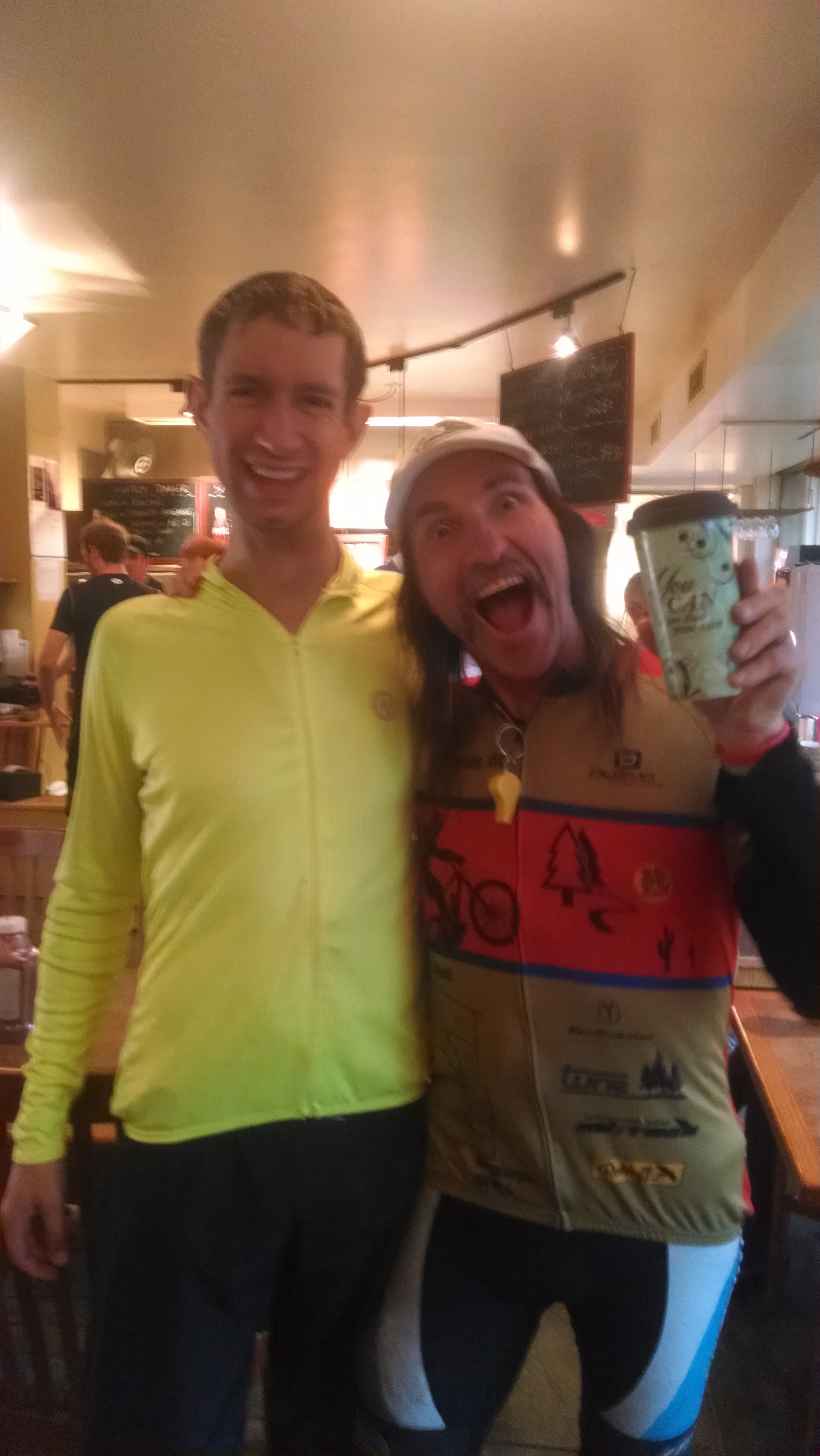
Crazy Larry. He’s one of the unofficial organizers of this unofficial race. He’s awesome. And a bit crazy.

IMG_20140612_080238764

I stayed at the YWCA, with about 60 other bikepackers. It was a fun hang. Bikes and cool gear everywhere.

IMG_20140615_141649662

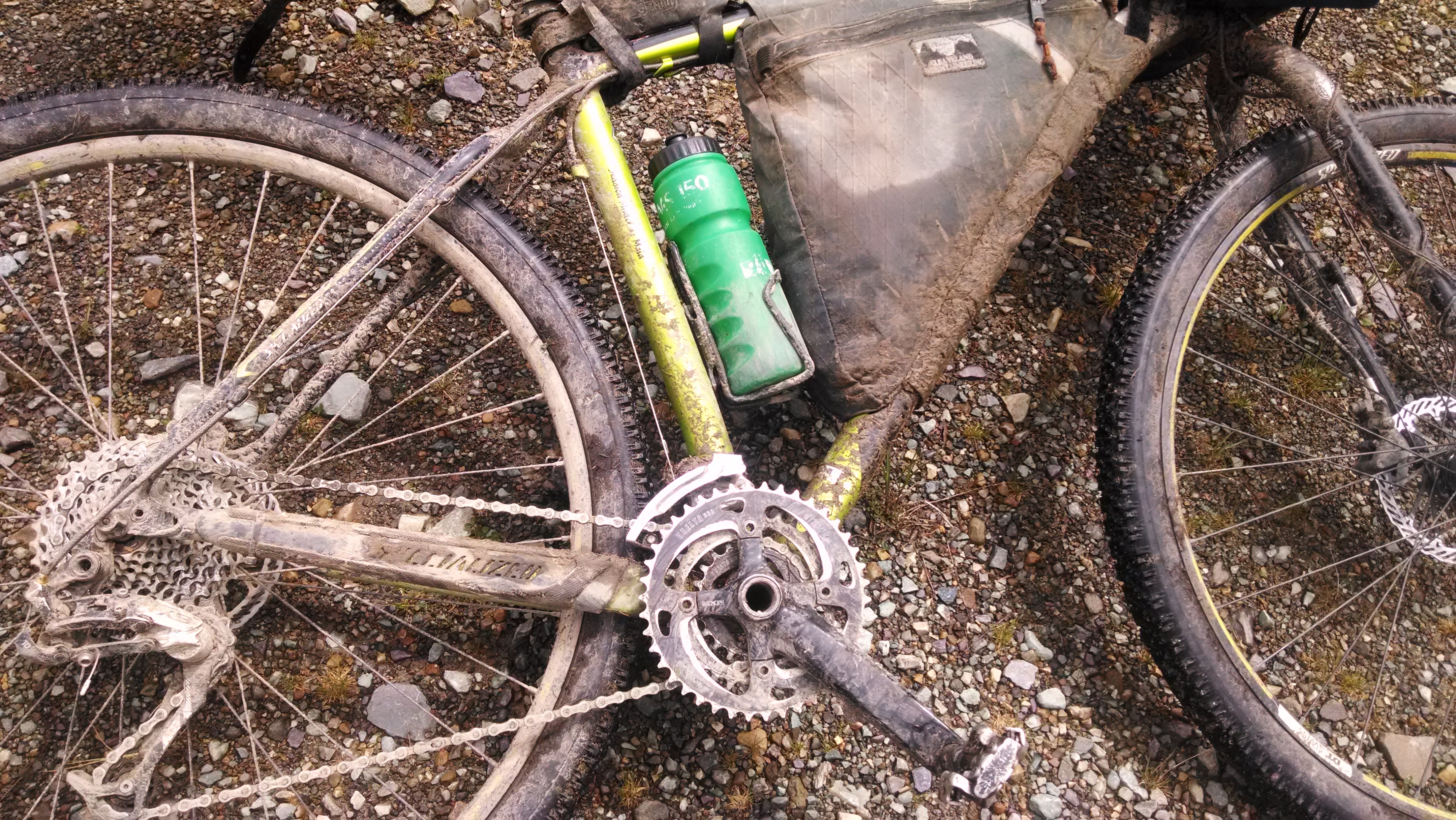
The bike after one hour of riding. We were hit with very cold rain right from the start. Within an hour it was snowing. Mud, mud, and more mud.

Finally we got started at 8:00 a.m. on Friday morning, but alas, the weather was unbelievably bad.  It rained every day, for hours and hours on end, with each day only giving us an hour or two of clear weather.  The rain was cold and it turned to snow up on the passes.

IMG_20140615_141700467_HDR

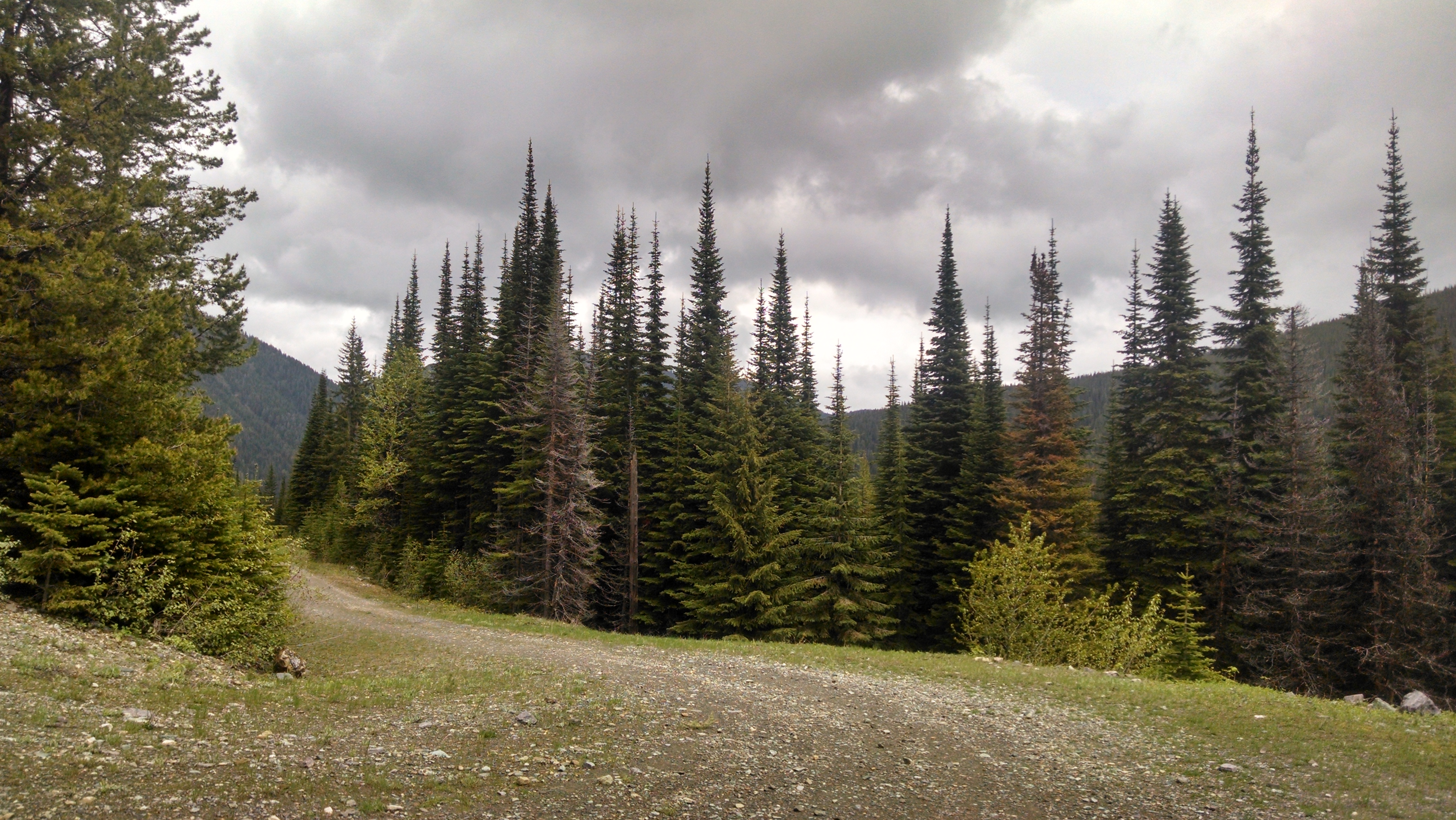
Ah, no rain. This was toward the top of Cabin Pass, a massive climb that took me several hours.

IMG_20140615_141707866_HDR

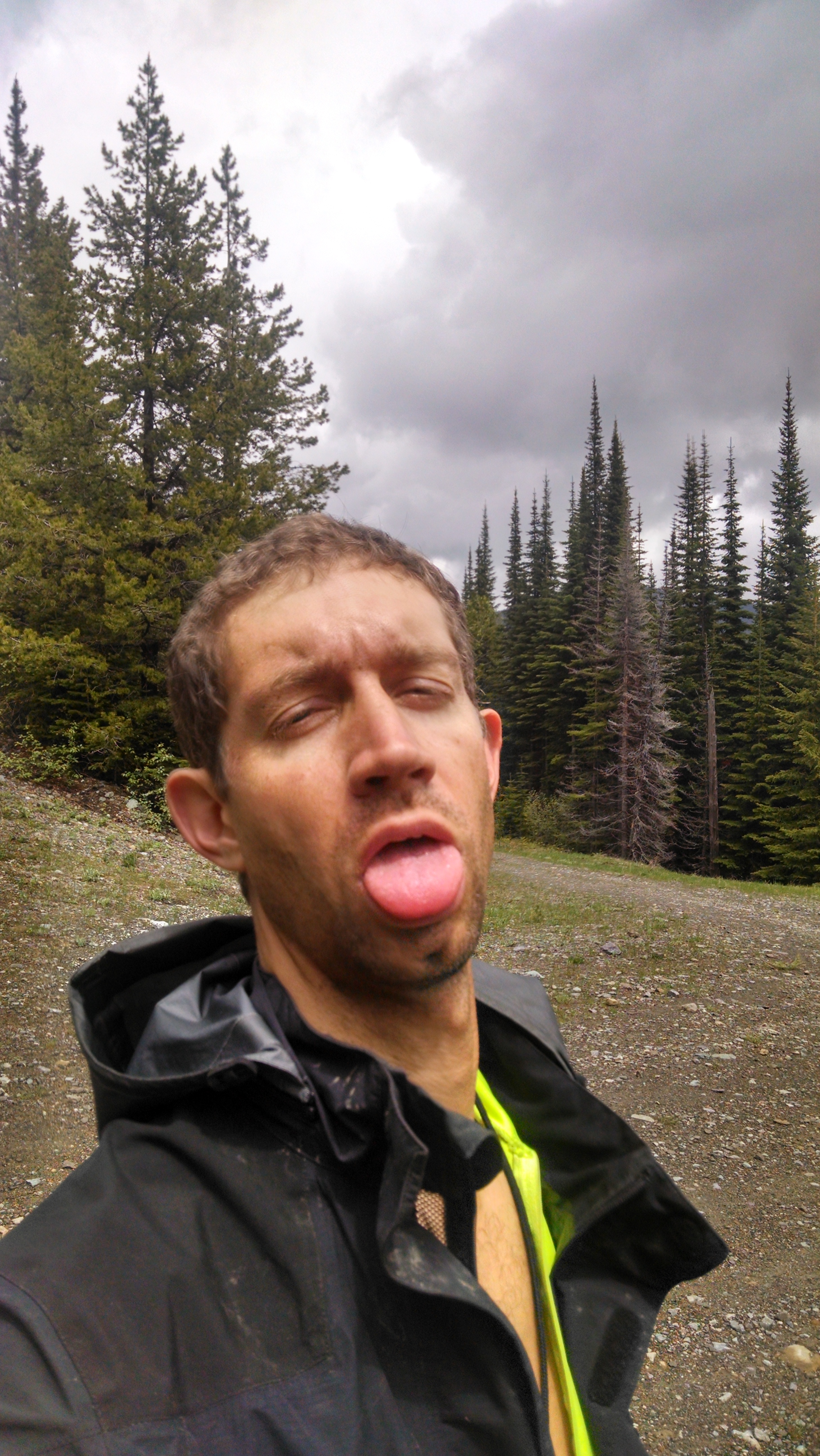
Also towards the top of Cabin Pass. That’s usually how I felt after climbing for hours on end.

My body and bike held up just fine, but I just wasn’t focused.  I’m going through a lot of big changes musically and professionally and I kept thinking I should be home practicing and composing.  However, I still averaged about a 100 miles a day this time, and finished 450 miles of the route in five days.  That was much slower than I had hoped for, but the elevation and weather was giving me some trouble.  I rode from about 6:00 a.m. to 10:00 p.m. each day.

IMG_20140614_081620061

The rain was relentless. This is a shot from the hotel floor on the second day. (I shared a room with four other dudes. $20. Perfect. It rained all night . . . ) I wasn’t the only one trying this. But it didn’t work that well.

The terrain was a mixture of single track, double track, gravel roads, and pavement.

IMG_20140614_093509816_HDR

Look carefully and you’ll see a few bikepackers towards the top of that hill. Singletrack/bushwack.

Sometimes the trail just disappeared and became a river, like this photo below of the bottom of Flathead Pass.  We had to carry our bikes for miles through the icy cold water, or try to navigate the brambles on the side of the “road.”  Fun!

IMG_20140614_171016531

I rode with other people off and on.  I never tried to catch up to stronger riders as I didn’t want to injure myself.  That was a good strategy.

IMG_20140615_204031245

All this junk food plus some slices of pizza in my back pocket would keep me going for another 100 miles of rugged wilderness. It’s not great food, but it’s portable, doesn’t go bad, and is all that’s available in small towns.

IMG_20140616_141154437_HDR

When the sun did come out for a few minutes my cockpit would become a clothes rack.

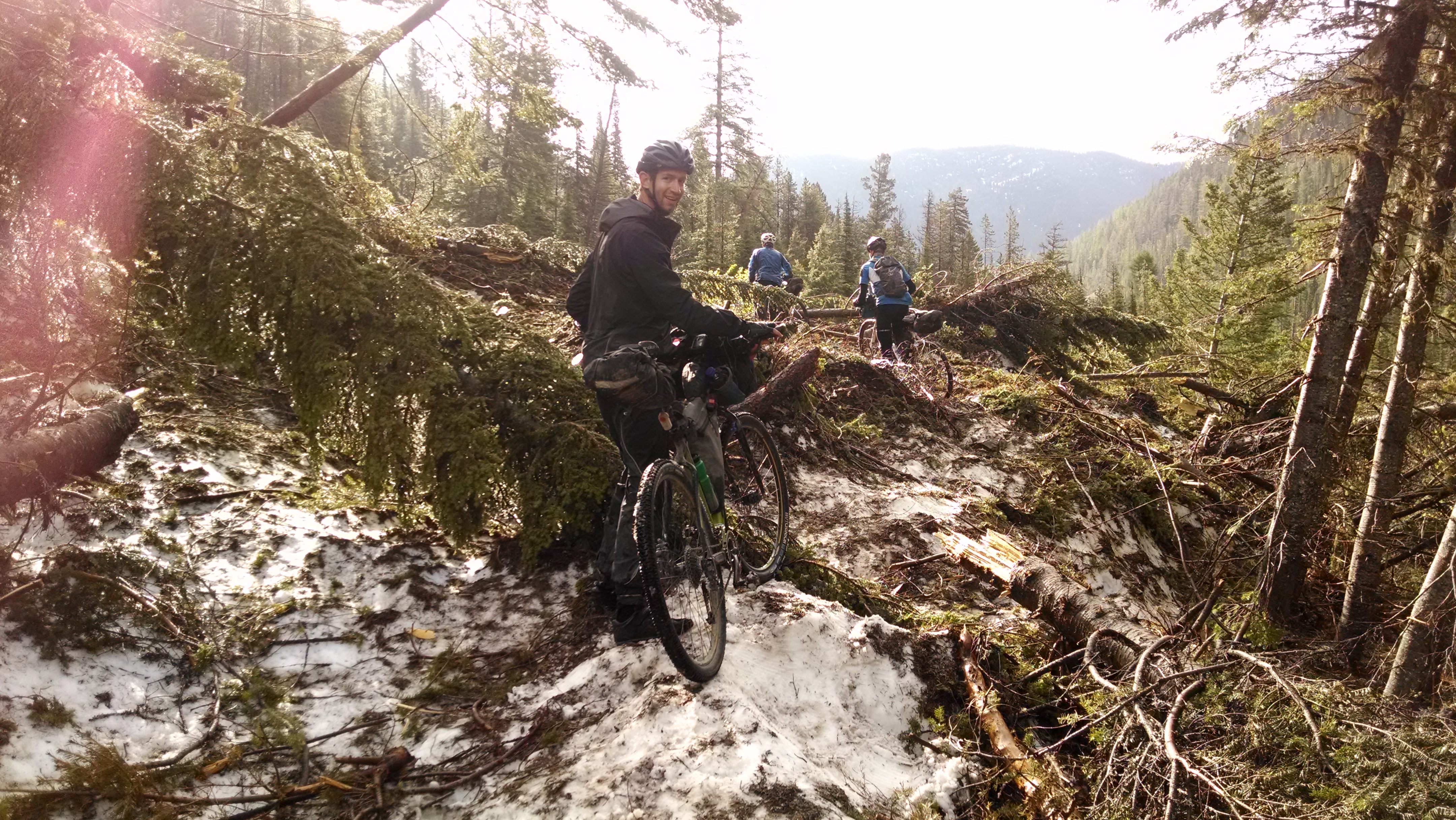
There was a lot of hike-a-bike.  Miles and miles every day.  In the photo below are some avalanche remnants across the trail on Whitefish Pass in Montana.

IMG_20140616_084143445

IMG_20140616_151851913_HDR

Top of Redfish Lake Pass. Gorgeous place. I was by myself for most of the day and had a lot of time for thinking, which is always more clear in the wilderness.

  So, somewhere in the middle of Montana I called it.  I have no regrets.  It was an incredible experience.  I’ll be back next year and I look forward to finishing it.  Not a second goes by that I don’t think about that route.  It’s very original and American in all the right ways.  There’s nothing else like it in the world, riding the spine of our continent from one end of the country to the other.  I really appreciate Jessica’s support.  She “gets it.”  I’m a lucky guy.  I also appreciate all the efforts of the people behind the scenes, like Matthew Lee, Joe Polk, Crazy Larry, and the folks at ACA.  Congrats to the riders who finished.  One day I’ll be able to say the same.


Performance/Lecture at India Culture Lab

Last night I enjoyed performing and lecturing at the remarkable Godrej India Culture Lab. I was amazed to see a large corporation running an experimental, interdisciplinary program with the only goal of exploring and seeing what might be possible. Many American corporations have open-ended R & D departments, of course, but they are technical in nature and ultimately the goal is produce revenue-boosting products. Once again I’m impressed with how much energy Indians invest into the arts and creative thinking. Special thanks to Sachin Nikarge and all the good folks at USIEF for initiating this event and bringing me down in such a nice fashion.

Parmesh Shahani runs the India Culture Lab. He’s an intelligent and gregarious man who travels constantly and has an insatiable intellectual curiosity. It was clear he runs a tight ship, but with a healthy dose of irreverent humor. Hi colleague Diane was my host and she showed me around and made sure I was comfortable. She was especially keen to show us the warehouse where they had hosted a large multi-media/audience-participation event the previous year. On a long afternoon over 7,000 people attended the event. Impressive, to say the least.

I started with a short performance of John Cage’s “Solo No. 58” from his opera Song Books, in Dhrupad style. The performance went well, though I’m still quite uncomfortable singing with a microphone. My voice isn’t as stable or rich when amplified, but I think the solution is just to perform more and spend more time with the mic and find the right space. (I have one at home I can practice with.) After I sang for a bit I gave a lecture on Indian/America fusion music, especially the music of Terry Riley, Michael Harrison, Shawn Mativetsky, and Reena Esmail. The audience seemed to enjoy the talk and I fielded many good questions afterwards. I always enjoy sharing my music with non-specialists. They often hear music in ways I don’t since I’m so deeply entrenched in the technical aspects of being a professional musician. All in all, it was a fabulous way to end a life-changing Fulbright experience.

Dhrupad FAQs

Many of my friends at home have asked me about Dhrupad, so here are some questions and answers:

What is Dhrupad?

In India there are two major systems of classical music: North Indian Hindustani and South Indian Carnatic.  Dhrupad is a genre of music from the North Indian Hindustani system.  Dhrupad is characterized by long tones, extreme precision of tuning pitch, and the use of syllables such as “ahh ruh nuh nuh.”  Some scholars believe these syllables have their roots in a particular Vedic chant.  Dhrupad performances typically unfold in four parts: alaap, jor, jhala, and bandish.  The alaap, jor, and jhala only use the syllables, and increase in rhythmic density and complexity.  In a full Dhrupad performance these sections may take at least an hour.  The “bandish” is the composed composition, using text. The barrel drum the pakawaj joins here.  Dhrupad includes improvisation, of a highly codified and sophisticated nature.

Dhrupad is said to have originated from an even more ancient religious music form, Prabandha (2nd to 7th AD). The language of Prabandha was preeminently Sanskrit, whereas Dhrupad used mainly medieval Hindi or Brijbhasha. Today, modern Hindi is also used. The word Dhrupad is the Hindi form of the original Sanskrit, Dhruvapada, a combination of Dhruva = structured or rigid, and Pada = word.

The birth of Dhrupad coincided with the Bhakti movement of Vallabh Sampradaya and resultantly was devotional in nature. Dhrupad was sung in temples, the singer facing the divinity or it was sung by Vaishnav mendicants in their wanderings. This was the genesis of the Haveli Dhrupad. From this early chanting, Dhrupad evolved into a sophisticated, classical form of music.  (Last two paragraphs from Uday Bhalwalker’s website)

How does one learn to sing Dhrupad?

One learns this music directly from a guru, or teacher.  Dhrupad can’t be learned from books or audio tapes or YouTube videos.  One must apprentice under a master teacher for several years to gain the proper understanding and techniques.

 Is it difficult?

It is extremely difficult.  I have a parallel career as a Western composer and percussionist.  I graduated from the most competitive schools, procured a tenure-track job, and have toured the world in that capacity, performing Western classical music in top venues like Carnegie Hall, so I can state with authority that singing Dhrupad is as difficult as learning Western classical piano or violin or percussion.

Can a non-Indian learn this music?

Yes!  There are many non-Indians performing Dhrupad at a high level all over the world.  The color of one’s skin or country of origin is no matter.  Just as people from Asia or South America have become virtuoso Western classical or jazz musicians, so have many Westerners become virtuoso Dhrupad performers.

The singing style is different than Western classical singing, right?

Yes, it is.  It is a totally different voice culture.  Dhrupad singers never use vibrato, as that would destroy the pitch precision.  We also use more resonance in the nasal cavity, though a proper Dhrupad voice should always be rooted in the throat.

Does Dhrupad include improvisation?

Yes, though it is of a highly codified and sophisticated sort.  One doesn’t just “jam out” on a mode.  It takes years and years of dedicated to practice to learn to improvise correctly in the Dhrupad style.

But wait, I thought you had a career as a Western composer and percussionist . . . ?

Yes, I do, and I maintain that as well.  I’ve learned over the years how to balance the forms of music and practice more effectively to maximize my time.  It is possible to do both at a high level, though one must be extremely disciplined.

What is the drone instrument and why do you use it for Dhrupad?

The drone instrument is called a tanpura.  It is the large, guitar-like instrument with four strings.  Typically one of the lead performer’s students will play it, seated behind the soloist.  The strings are tuned so as to emphasize the root note of the raga, the tonic, or the shaddhaj.  Tanpuras are magical instruments.  When tuned properly they emit a whole rainbow of fundamentals and overtones, producing a highly complex sound field called a drone.  This drone is essential for Dhrupad performance.  Every note a Dhrupad performer sings or plays must either disappear into the drone or bounce back from it in a very specific way.  The pitch precision of Dhrupad is only meaningful in combination with a tanpura; one needs the tanpura as a reference point for each note.  Some performers also use electronic tanpuras, especially for practicing or performances where it isn’t possible to use a real instrument.

Is Dhrupad “hippie” music?  

Many Westerners associate Indian classical music with Ravi Shankar and the “hippies” of the 1960s, and the attendant drug and free-love culture.  This is regrettable.  Most Indian classical musicians are highly disciplined people who work very hard at their art form and live a conservative lifestyle.  Indeed, Ravi Shankar himself was such a disciplined musician and while he was glad that Westerners were interested in his music, he discouraged his Western students from using drugs and leading a sloppy lifestyle.  This music is far too difficult to practice or perform while stoned or tripping.

Is Dhrupad a kind of meditation?

Yes it is.  Listening to Dhrupad will clear your mind and body and open up you to higher levels of thinking and feeling.  And it will also energize you if you listen carefully.  When I hear a good Dhrupad performance I have tremendous amounts of energy for days.  It is both calming and energizin

Is the tuning system different than Western music?

Yes, if you mean the Western piano, which divides the octave artificially into twelve equal notes.  This system is called Equal Temperament, and while it has advantages for the harmonically-advanced music that developed in Europe in the 19th century, it is very square and unnatural for modal music, which is what the Indian system is based on.  Dhrupad musicians mostly sing justly-tuned intervals, that is, intervals with low ratios that are found in the natural harmonic overtone series.  (E.g., a 3:2 for a perfect fifth or a 5:4 for a major third.)  These intervals feel quite different than the intervals you hear from a modern piano.  They resonate in your body and your mind in a very different way.  They’re not necessarily better than Equal Temperament, but I argue that they are more natural for singing over a drone.  That being said, my favorite percussion instrument is the marimba, which is in Equal Temperament!  I’ve performed hundreds of concerts as a marimba player and the instrument sounds beautiful to me.  The tuning discussion is far too complicated for a FAQ.  Take me to a sushi lunch and I’ll explain in detail; it is quite fascinating.

Some Dhrupad Artists who have made recordings and have YouTube videos that you should check out:


Gundecha Brothers (the best!)

Uday Bhawalkar (also amazing!)

Nancy Lesh-Kulkarni (a Westerner who has mastered Dhrupad on the cello, a wonderful musician)

Senior Dagar Brothers

Sayeeduddin Dagar

Z.F. Dagar

Z.M. Dagar

Manik Munde

Bhavani Shankar

Wasifuddin Dagar

Ritwik Sanyal

Mallik family

Audience participation pieces

I just finished two large orchestra pieces. One is called Concerto for Quintet, Orchestra, and Audience and is about 14 minutes long. I wrote it for Classical Jam and the Maryland Classic Youth Orchestras. Both ensembles are outstanding.

The second piece is called People Coming Together and I wrote it for the Bloomingdale School of Music. They have an excellent commissioning program and I’m part of a lineage of composers they commission each year that includes Elliott Sharp, Frederic Rzewski, Caleb Burhans, and others.

Both pieces include audience participation. Before the performance begins the audience is coached on humming a note, snapping their fingers on cue, and reading various texts. All of these create a kind of atmospheric, controlled crowd noise.

I wasn’t wild about doing this at first, but Peter Robles (my manager) and especially Wendy Law (the cellist from Classical Jam) really liked the idea and pushed me on it. I was worried it would be “cheesy” or gimmicky, but upon further thought I think my worries were unfounded. I was hoping that this would bring the audience closer to the music and I think I might succeed on that account. I was at a performance recently where the singer did some call and response things and I was surprised at how eager the audience was to join in. We’ll see how it goes, but right now I’m feeling optimistic.