Recently my old friend and mentor Paul Gongloff passed away. You can read the obituary HERE. I knew Paul when I directed the church choir at Christview Methodist church near Rochester, NY, from 1998 to 2001 while I was working on my graduate degrees at the Eastman School of Music. He hired me and quickly became a trusted friend and guiding light in my life. I haven’t seen him in person for about 15 years, but we emailed back and forth many times a year and also connected via phone from time to time.
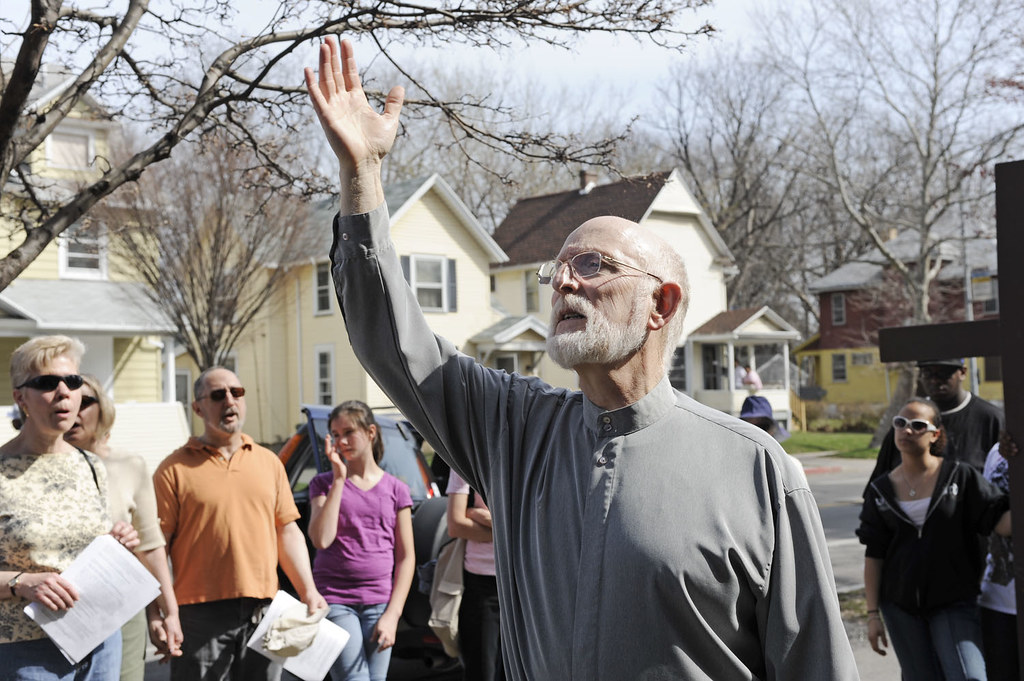
Truth be told, I had (and still have) a conflicted relationship with organized religion. But what was special with Paul is that he welcomed my questions; indeed, he had quite a few himself! He was never judgemental. He was always patient. At least once or twice a month we’d get a drink after our choir rehearsal and talk for hours about God, life, friendship, family, music, and the arts. Paul was insatiably curious, and endlessly patient. I never once heard him utter a negative word about anyone. He knew God’s grace was endless and mysterious and focused his energies on finding the good in each of us, and giving each of us permission to be ourselves and to find our own path through life.
While I’ve had a conflicted relationship with organized religion, I’ve always had a good relationship with Jesus and his teachings. He was an awesome dude, uncompromising in his love and open-heartedness, a true radical who saw the value in every person, regardless of how they look or where they come from or how much money they have. I’ve never been able to live up to that level, but I try, and when I’m trying I most often think of Paul, who was a constant source of inspiration and guidance. One of the speakers at his funeral said something I’ll never forget: “A death ends a life, but not a relationship.” I’m very sad Paul is gone, but in a way he never will be. Our relationship will continue.
It isn’t necessarily the specifics of what we talked about that has stayed with me all these years, but rather the general attitude and approach. Paul was a traveler. He traveled the physical globe, but he also traveled the infinite expanses of the human mind. He was curious, probing, courageous, open. One of the books of the Old Testament that we discussed at length is the Book of Job. I’ve always felt that book is central not just to Judea-Christian worldviews, but any spiritual relationship. We know that when innocent beings suffer it is wrong, therefore, how can we put our faith in a God that allows innocent people to suffer? Unfortunately, the answer isn’t very comforting:
“You don’t know.”
“Where were you when I measured the lengths of the Earth? …” (38:4) and on and on goes God, patiently but clearly explaining to Job after listening to Job wail and moan about the cruelties inflicted upon him, despite him having been a most dedicated servent of God (or at least of God’s gifts!), that no matter how hard we try, we will never understand why bad things happen, especially to good people. This is really an invitation into the mystery of the unknown. But that’s a very frustrating invitation indeed for a species that seeks understanding!
But Paul always seemed to get what God was saying in that seminal book, perhaps more than any other person I’ve known. We don’t know, and we won’t. We can try, and there is great value in that, but no matter how many atoms we learn to split, no matter how many symphonies we write, not matter how many people we send to Mars, there are bigger and greater mysteries to engage with, always and forever. It is infinite. That mystery can frighten us or it can excite us.
Paul was excited about the mystery, and that excitement was infectious. He was constantly reading and recommending books and trying out new ideas and new approaches to theology and living. I learned a lot from Paul, but the gift he gave that I will forever cherish is the gift to keep engaging with the mystery, to keep learning, to keep growing, and above all, to keep loving. Love might be the greatest mystery of all, an awesome power that transcends time and space, that ultimately guides almost every decision we make. What do we love? Why? How do we love? How do we love better? Those were the questions Paul asked, over and over, engaging with the mystery, with a smile, some really creative soup, a book recommendation, a favorite 19th-century hymn, and an endearing laugh that brought a smile to everyone who had the good fortune to know him. Knowing Paul and his wife Nancy, who was always there by his side, an amazing woman of piercing intelligence and warmth, who I’ve also admired for all these years, was really a blessing.
I miss you, Paul. Rest in peace, and thank you for all you gave us.
 Payton MacDonald
Wow! What a wonderful tribute!
MAM